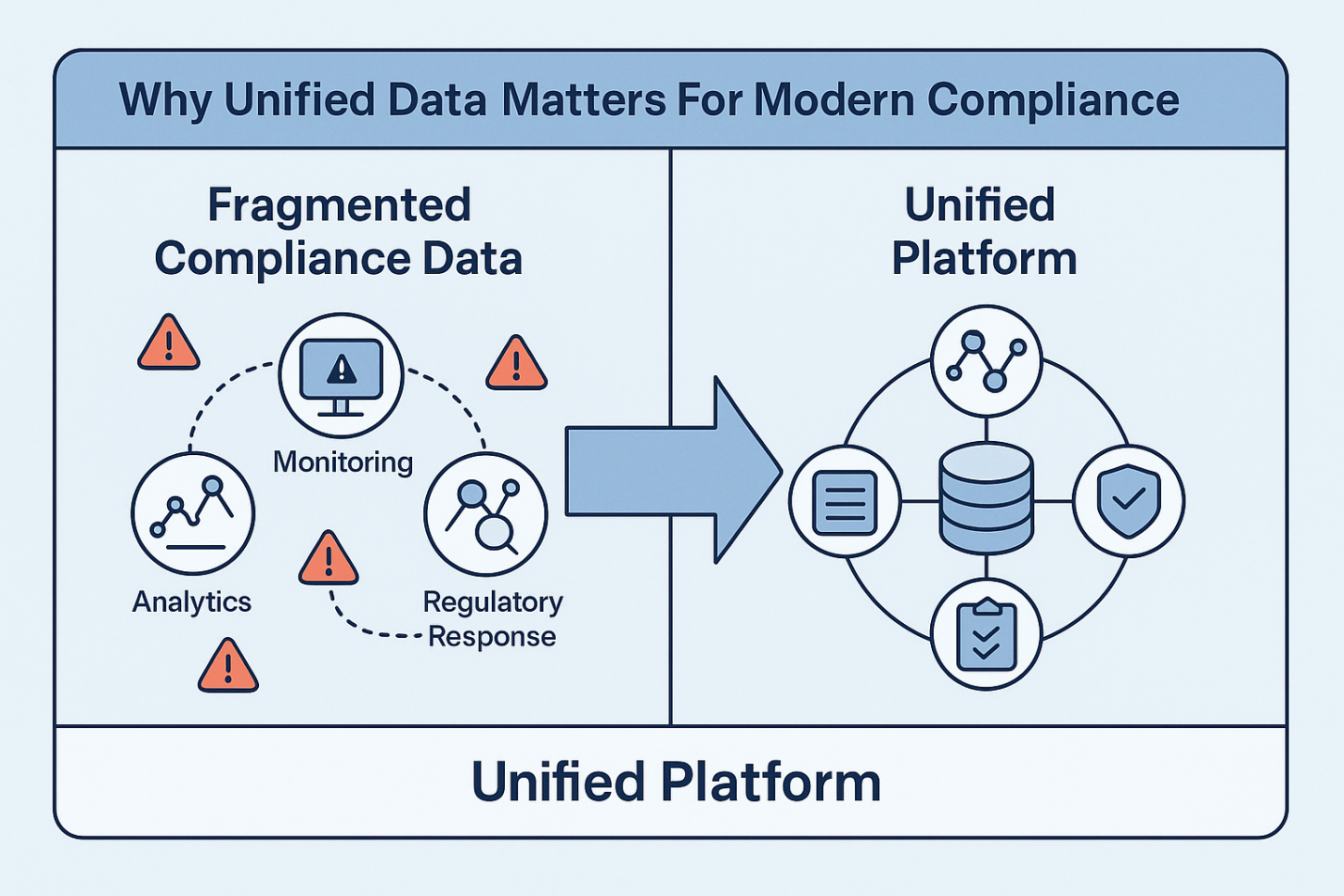
Financial institutions depend on accurate and accessible data for daily operations, regulatory reporting, and risk based decision making. Yet many organizations still struggle with information scattered across legacy systems, regional offices, and specialized tools. Fragmentation creates blind spots that limit risk visibility, slow investigation times, and weaken defenses against fraud, money laundering, and cyber driven crime.
Research from Deloitte illustrates that more than 70 percent of compliance teams spend most of their time gathering data instead of analyzing it. The challenge grows when onboarding systems, transaction monitoring engines, sanctions screening, and case management platforms do not share a consolidated customer view. When reviewers must manually assemble information from disconnected sources, critical issues often surface too late.
Unified data is no longer optional. It is the foundation for reliable compliance outcomes, effective fraud prevention, fast investigations, and scalable digital growth. The impact becomes clearer when examining how fragmented data disrupts both operational efficiency and regulatory readiness.
What Does Compliance Data Fragmentation Look Like?
Data fragmentation takes many forms depending on a firm’s history and systems. In financial services, it often appears when:
- Transaction histories, identity records, and risk scores exist in separate tools
- Screening and case resolution platforms cannot share information in real time
- Analysts depend on spreadsheets for evidence gathering
- Regional branches run independent tech stacks without central oversight
- Mergers leave institutions juggling multiple incompatible systems
This fragmentation forces compliance teams into reactive behavior. Instead of assessing risk through a complete relationship lens, institutions evaluate isolated events without context. That weakens investigative accuracy and increases false positives.
A deeper perspective on fragmentation and its operational consequences appears in Overcoming Compliance Data Fragmentation, which explains how scattered infrastructures create friction inside monitoring workflows.
Key Risks Created By Fragmented Compliance Data
Blind spots in AML and fraud detection
Criminal networks intentionally spread activity across multiple channels. Without unified datasets, pattern recognition becomes unreliable.
Real outcomes include:
- Missed connections between high-volume transfers and linked identities
- Inability to detect mule accounts using shared devices or IP addresses
- Screening results overlooked when onboarding and payments tools are disconnected
- Velocity bursts or structuring events left unnoticed
FATF reporting highlights data fragmentation as a core reason institutions fail to prevent laundering and terrorist financing activities.
Slower investigations and regulatory response
Time kills insight during financial crime investigations. When analysts must jump between tools, cases slow dramatically.
Common bottlenecks include:
- Switching between dashboards to cross reference identity, transaction, and device data
- Difficulty reconstructing customer timelines
- Inconsistent recordkeeping that complicates SAR filing
These delays weaken internal controls and increase exposure to enforcement penalties.
Higher operating costs
Disjointed systems create redundant data storage, overlapping vendor contracts, and expensive manual processes. PwC notes that AML compliance spending now exceeds 200 billion dollars annually, with much of that cost linked to inefficiency rather than technology quality.
Limited scalability and innovation barriers
Fintech growth depends on rapid onboarding, real-time payment rails, and automation. Fragmented data architectures restrict:
- Expansion into new markets
- Faster deployment of monitoring enhancements
- Adoption of AI driven analytics
Teams struggle to adapt because foundational infrastructure lacks flexibility.
Why Unified Compliance Data Enables Stronger Risk Control
A consolidated foundation transforms compliance efficiency and investigative power.
Complete case visibility
Unifying identity, transaction, device, and behavioral information creates a full picture that supports confident decision making.
Benefits include:
- Faster case reviews
- Fewer false positives
- Clear timelines supported by evidence
- Reduced duplication of analyst effort
More accurate customer risk scoring
Real-time updates grounded in full context outperform static, manually updated assessments. Integrated scoring improves segmentation, monitoring intensity, and resource allocation.
Real-time surveillance across channels
Unified datasets can identify network behavior instead of isolated events. That visibility exposes:
- Clusters of related accounts
- Suspicious cross-border movement patterns
- Multi-platform abuse involving mobile, card, and wire transfers
AI and analytics that deliver measurable outcomes
Machine learning models require comprehensive datasets to function well. When data is fragmented, models cannot recognize behavior trends or fraud signals with reliability. Unified platforms enable predictive analytics that detect anomalies earlier and stop losses sooner.
Strategies To Reduce Fragmentation And Strengthen Compliance Infrastructure
Standardize data across systems
Common data formats prevent incompatibility barriers and improve automated processing.
Increase API-based integration
Secure APIs enable real-time data exchange without human intervention or batch delays.
Replace legacy systems with structured migration plans
Target high-impact datasets first to accelerate returns.
Consolidate platforms where possible
Fewer tool silos reduce complexity and lower risk exposure.
Establish strong data governance
Assign clear ownership, quality standards, and review processes.
Adopt cloud infrastructure for scalability
Cloud systems support global operations, rapid deployment, and unified data access.
Training And Culture As Core Drivers Of Integration
Unified data succeeds when organizations align culture with technology.
- Promote open knowledge sharing across compliance, fraud, cybersecurity, legal, and product teams
- Encourage continuous education in analytics, regulatory change, and digital tools
- Support cultural alignment focused on transparency and accountability
People are the backbone of data-driven transformation.
The Future Of Compliance Data Management
Global compliance expectations continue to move toward real-time insight and automated evidence trails. Data unity is set to become a defining factor in regulatory credibility.
Expected developments include:
- Real-time anomaly detection across interconnected financial ecosystems
- Cloud-native case automation with explainable AI
- Graph analysis to map networks of accounts, devices, and identities
- Automated regulatory reporting based on structured event logs
- Increased demand for consolidated audit-ready architecture
Institutions that delay transformation will face widening compliance gaps and higher risk exposure.
Why Unified Platforms Help Firms Keep Pace With Regulators
Regulators increasingly expect efficiency, transparency, and data proof for decisions. Enforcement actions from the past decade repeatedly show that disconnected systems contribute to missed warnings and compliance failure.
Modern technology providers support unified risk infrastructures that reduce fragmentation and centralize monitoring. A comprehensive AML compliance solution like Flagright integrates transaction monitoring, sanctions screening, risk scoring, and case management into one real-time platform. That approach helps institutions replace patchwork systems with scalable architecture built for growth and regulatory confidence.
Financial crime evolves quickly. Unified data is the advantage needed to stay ahead and safeguard trust in global finance.
Institutions that embrace consolidation over fragmentation strengthen security, reduce cost, and build resilient compliance futures.